

Scott Nash recalls waking up on the morning of Sept. 11, 2001 around 6:15 a.m. Just like every other morning, the professor of Christianity at Mercer made his 15 mile commute to campus and taught his 8 a.m. class in Knight Hall, Room 303.
He remembers casually making coffee for the department as he awaited his 9 a.m. class. Suddenly, his secretary, out of breath, frantically told him that he better check the news, that something terrible had happened.
“I rolled a cart with an old TV into the classroom so I could see what she was talking about,” Nash recalled.
After spending a few moments getting a signal, a news broadcast containing live footage of the World Trade Center began playing.
Then, nearly thirty students in Room 303 saw the World Trade Center’s South Tower struck by United Airlines Flight 175 live on television. “The room was utterly subdued,” the professor remembered.
The minutes of silence that followed were broken only by Nash: “Class is canceled.”
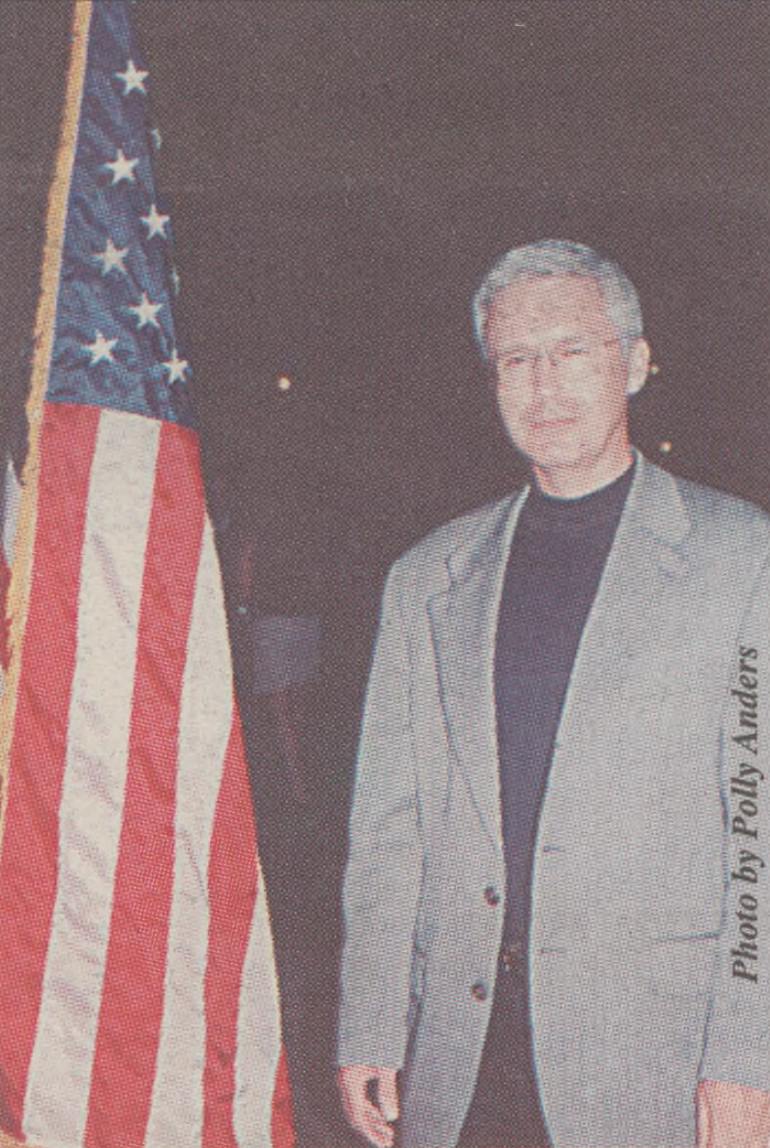
Scott Nash stands beside an American flag on the Mercer campus in the weeks following Sept. 11, 2001.
The morning of Sept. 11, 2001, was a morning many on campus would never forget. On the grounds of Mercer, the event unfolded with a mixture of shock, horror and disbelief for teachers and students alike. A quarter of a century later, many still remember the day.
Darlene Flaming, professor of religion at Mercer, remembers waiting for students to turn in a paper that morning when the towers were struck.
Flaming said students arrived to what was supposed to be her 11 a.m. class and explained how they had no papers to turn in. For the past few hours, she said, they had been hardly able to function–much less write.
Flaming described experiencing that similar feeling of dysfunction herself that continued for a week after the events.
“I felt like I hadn’t breathed in a week,” said Flaming as she recounted walking around Tatnall Square Park in the days after the terrorist attack. For years after the attack, Flaming recalls still using the violence and horror of the day to explain to students in her biblical lessons.
“In my Hebrew Bible class, when I was teaching the destruction of the first temple I would use 9/11 as an illustration for how significant the attack was to the Israelites," she said. "Students would immediately get it."
The moment was immediately personal for Nash as well. He recalled that he had flown many times through Boston’s Logan International Airport–the very same airport that both terrorist flights that day left from.
“I remember seeing the footage of people covered in rubble on replay for hours on end,” said Nash. “My primary concern was for the family and victims,” he said.
Responses from the student body included a candlelight vigil hosted by the Student Government Association on Sept. 18, the week after the attacks. Nash himself spoke at the event, emboldening the attendees with a story of a personal tragedy during his speech and speaking about the value of changing in response to horrible events.
"It has to mean something... something lasting, even life-changing. If it doesn't, then then the normalcy to which we are trying to return is itself meaningless... life itself will mean less," he told those assembled at the vigil.
The university also held an assembly in Willingham Hall following the attacks, where then-president of Mercer Kirby Godsey gave his thoughts on the tragedy and how students should respond.
“Yesterday was, by any measure, an unprecedented day in the history of our nation. Nothing in our history compares to what happened yesterday,” he said, according to a script of his speech.
“Evil is irrational. That is why we find it so difficult to speak because we are trying to speak of that which is not rational. It makes no sense, and when we are faced with what makes no sense we are thrown in silence–utter, utter silence–unable to speak. But you and I live in a world where chaos prevails," Godsey said.
He made a point of acknowledging that the scars the nation had suffered could be used for good.
“I am sure that we will never quite be the same as people, but we can become stronger people and we can become more civilized people," he said.
“So, the work of this University, its highest and most important work, is to plant seeds of hope for tomorrow and for a new generation. We are huddled together as a University community to touch each other, to connect with one another, and to say we will be together and continue our work, continue to live as a community who are bent on planting seeds of hope for a new day," he said.
What Nash, Flaming, Godsey and everyone on campus immediately understood was that the course of American history had been forever changed by the events of Sept. 11.
"I never remember seeing American flags in people’s yards or having one in my own," Nash said. "But after that day, it felt like we all did."


