
This is an opinion article. Any views expressed belong solely to the author and are not representative of The Cluster, any organizations the author is a member of or the faculty, staff or administration at Mercer University.
Before President Donald Trump took the stage last weekend during his rally in Perry, I peeked to the left. Then I looked right. Maybe behind me? It didn’t make sense. After all the talk I’d heard of the young men that would vote MAGA and take back their country, I was somewhat surprised to see a mostly elderly crowd.
But after all, Trump is losing popularity. His approval rating is down to 33% according to a recent Washington Post-ABC News-Ipsos poll, and Georgia Republicans like Gov. Brian Kemp and gubernatorial candidate Rick Jackson are quietly shifting away from the president’s MAGA stronghold. So maybe it’s not as surprising that even the most conservative college students would stray from Trump’s rally, too.
But I’m still shocked that women at Mercer who major in fields like public health, political science and even journalism can’t put a name to Keisha Lance Bottoms, who has a shot to be Georgia’s first female governor.
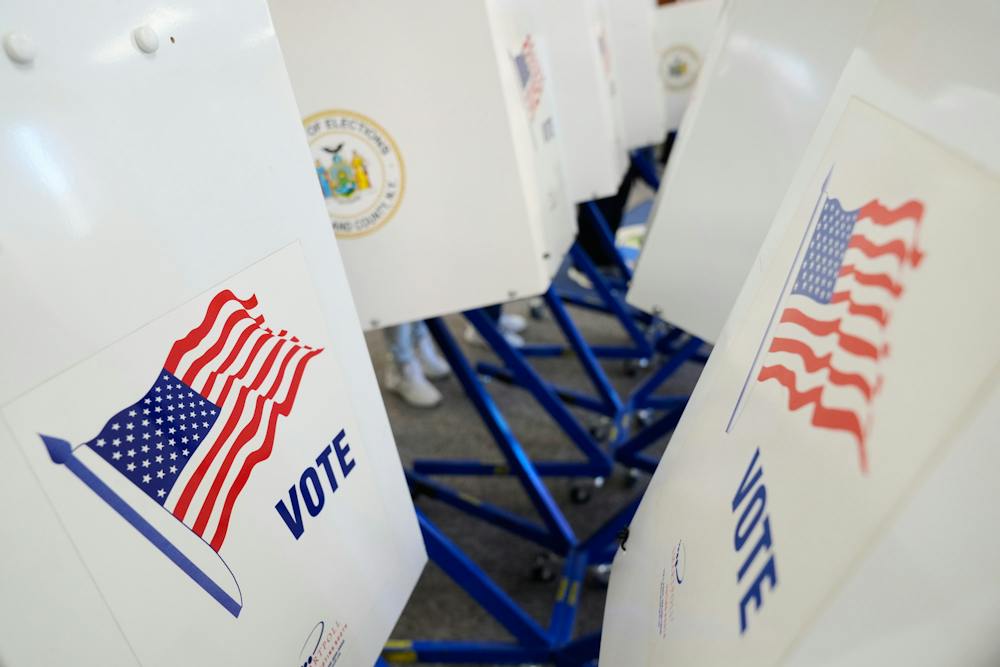
I’ve interviewed about a dozen students leading up to this year’s midterms and casually talked to two dozen more. I’ve come to realize that, despite Mercer’s stellar voter registration numbers, many of my colleagues don’t even know who’s on their ballot. And if they do know the names, there’s still no guarantee that they’ll vote.
And it’s not that young adults are apolitical. They just don’t feel represented in the two-party system. In a Tufts poll, 43% of Gen Zers said they don’t align themselves with a party. Issues like affordability, healthcare and immigration take the forefront rather than party lines.
So far in the early voting period, Bibb County’s youth voter turnout was abysmal — not even scraping 1%, according to the Secretary of State's office. 18-24 year olds are the least active voters, despite being among the most vulnerable to certain policies.
All the steamy political topics hit me close to the heart. I’d like cheap gas about as much as I want a new Porsche. I want to feel safe in my community. I’d like to see leaders that represent my values. That’s why I hit the polls, but meatball campaign mottos aren’t exactly swaying for young voters.
What is swaying, at least for me, is a candidate who takes the initiative in speaking with college students. Earlier this semester, Bottoms, Lt. Gov. candidate Josh McLaurin and Public Service Commission candidate Sheila Edwards visited a group of about 40 students in Godsey Science Center. The three Democrats talked exclusively to Mercer students and gave room for us to feel heard by our potential leaders.
Jackson has yet to make a public appearance on a college campus during his campaign, and hasn’t spent much time in Middle Georgia this year. I’m not here to convince anyone to favor Democrats’ policies (which aren’t without their criticisms), but it’s notable that three candidates made stops on their campaign tour for a group of students that didn’t even fill a lecture hall. Students said they felt heard and seen by candidates, which doesn’t typically happen behind TV screens or podiums. That extra mile could motivate Gen Z to drive to their polling stations by Nov. 3.
We’re fighting against the oldheads. According to Pew Research Center, the median voter age in 2024 was 48, meaning the average voter came up during Bill Clinton’s “Third Way” centrist reform, moving away from the more polarized generations before them.
I liken Gen Z more to the young voters of the 60s and 70s — a loud, audacious and demanding group that refuses to settle for poor policy. They showed off that vibe during the Black Lives Matter movement of 2020, or in the demands to see the Epstein files or most recently in the outcry over the Cornell Seven. In those last two events, conservative and progressive minds alike have blended into cohesive frustration.
We need to show that audacity in the voting booth. We need to tell the country that we’re not going to sit on our hands. Even if Gen Z can’t cherry pick a 25-year-old candidate, Democrats and Republicans could find themselves gearing their agendas toward young voters if the turnout rises.
Gen Z is voting to represent our age group in a country that continuously bashes us down for being too young, misinformed and emotional. As college students, we’re facing funding cuts to higher education. As future workers, we’re facing an unstable job market. As future (or current) parents, we’re facing housing costs that feel wildly unmanageable.
Even if you’re a freshman, the governor that Georgia picks will hold power while you’re moving on to your next phase in life. The public service commissioner will decide how close you live to a data center. The senator will choose if you can get healthcare access.
Gen Z isn’t lazy. They get out into the streets, write in their blogs and question their leaders every day. But now it’s time to command respect as voters, and force this country to tolerate our audacity.
Nathaniel Jordan '29 is a Journalism and Anthropology major at Mercer, and plans to become an investigative journalist. He enjoys older pleasures like reading the Sunday paper and frequents local parks with his wife and son.


