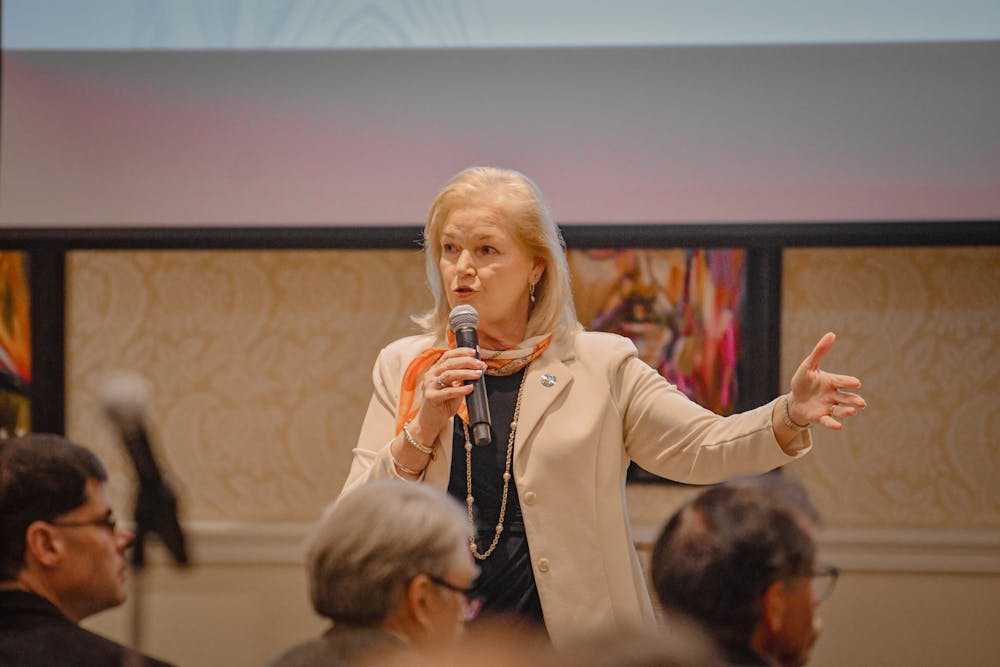
President Penny Elkins outlined Mercer’s next steps and gathered comments from a large contingent of faculty, staff and students during a Future Forward Forum on Thursday afternoon in the Presidents Dining Room.
The collaborative approach is intentional, Elkins said, so that future changes are made in concert with every stakeholder and all parties can “chart Mercer’s next course.” Following the last forum at the end of January, Elkins said the executive cabinet will review the information they receive, and will then convey the results to Mercer as a whole.
While those results will steer the administration in a new direction, Elkins said that some things will not change. The school’s mission to instill in students dedication to service and innovation, she said, is a bedrock principle of Mercer. Its vision, too, to “change the world, one student at a time,” will continue to guide the administration.
But in her inaugural semester, Elkins stressed that the University will respond to and work around external pressures that affect higher education today. The forum is part of the process to collect feedback from professors and students who are well aware of the issues that universities are facing.
Among them, the “enrollment cliff” is on the immediate horizon for higher education, she said, and members of the audience added they anticipated increased scrutiny of a college degree’s return on investment and difficulty in securing adequate funding for research.
“I’m excited that we’re going to do it together, understanding that there will be those challenges that will give us pause that we will know that we’ve got people around who can support us and who will, in fact, rally together to help us walk right through whatever is happening around us,” Elkins said.
Provost Lisa Lundquist presented results from surveys sent last week to faculty, staff and the student body, and respondents were instructed to rank what they believe are key issues that Mercer needs to address in three separate categories.
About one fifth of the 476 total responses were from students while about 75% of the respondents were faculty and staff.
In the first category, the top ranking concerns were that the University “update academic curriculum to align with engaging workforce needs” and “expand internship opportunities, employer partnerships and career development services.”
During the discussion of these results, members of the audience were able to give feedback on the results. Amy Nichols-Belo, associate professor of global health studies and anthropology, was not sold on a curricular restructure. Nichols-Belo instead said she believed the University should “translate” the curriculum as opposed to updating it outright.
Susan Cline, a professor in the School of Medicine, brought up “the two letters we’re all afraid of: AI.”
“How can we use [artificial intelligence] in education? We’re facing the issue of advising as well as preparing our graduates in the medical school, how they’re going to be using it,” Cline said. “We are behind already, and I think that’s one of the challenges we face, but it’s also an opportunity for realigning curriculum.”
The next survey result followed a similar trajectory as respondents indicated they wanted to “strengthen existing programs that demonstrate opportunity to more closely align with employer needs” at Mercer.
Again, though, there was pushback from some of the speakers. Registrar Paul McCord called for a measured approach to catering learning outcomes to “employer needs.”
“We do need to do it with caution because if we do too much to chase what the government is telling us to do to get the numbers, sometimes we accidentally chase the numbers instead of actually doing what our mission is going to do in this regard anyway,” McCord said. “So stick with the mission, and the results will happen.”
Jaime Stokes ‘26, a media studies and political science student, echoed Cline’s sentiment regarding AI and its place in academia, noting “that it’s important to recognize the changing world and do what we can to realistically prepare our students for the job environment that we are all desperately trying to enter.”
The final segment centered on Mercer’s ability to market itself not only in Georgia but across the Southeast as the University competes for attention from prospective students. As Mercer approaches the so-called enrollment cliff, the school has seen record-breaking enrollment over the last few years and hopes to improve its chances to weather the potential storm.
The banners across campus that trumpet Mercerians’ ability to change the world proclaim “an audacious statement,” Elkins said at the end of the forum, but “I want you to know that I think that’s true about all of us.”
Gabriel Kopp '26 is double majoring in Journalism and Law and Public Policy at Mercer University. He has written for The Cluster since he started at Mercer, and currently works as editor-in-chief. When he isn't completing a Washington Post crossword, he enjoys going for runs around Macon and reading The New York Times or the AJC while sipping coffee.