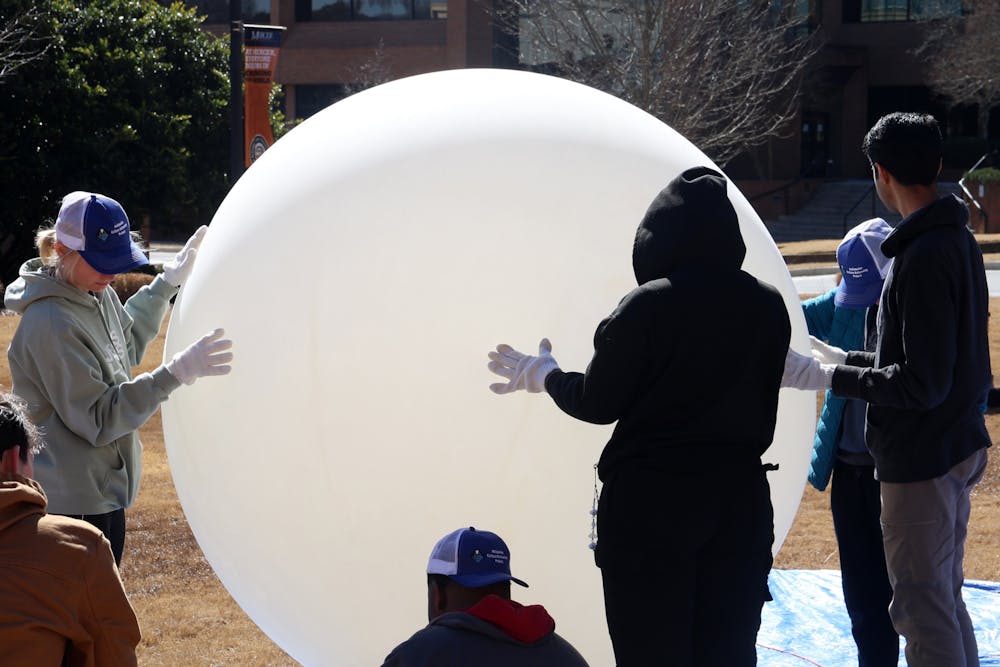
The Mercer Robotics Club is planning a retrieval mission for a weather balloon they launched from lawn of the Godsey Science Center into the atmosphere in partnership with NASA on Saturday, Feb. 7.
The balloon, known as a high-altitude research platform, flew approximately 20 miles into the air, which is nearly triple a commercial airplane’s cruising altitude before landing near the coast of Georgia, according to HARP Co-Lead Kalp Patel ‘27.
The balloon ended up in a large, dense forest near Riceboro, Ga. due to windy conditions, which was two and a half hours from the launch zone. The chase team, tasked with retrieving the balloon and its payload, was forced to abandon the retrieval effort for the night due to a lack of light, according to Patel. He said the team plans to recover the balloon later this week before the tracking devices’ batteries die.
Over the course of about five hours Saturday morning, the organization attached two styrofoam boxes that held equipment such as a cell phone, a 360-degree camera and a cosmic watch. Patel said the cosmic watch can track particles in the atmosphere that are difficult to detect from the ground.
“There’s stars and explosions, like supernovas and stuff, that spill out all these particles into space,” Patel said. "We want to collect data on them.”
Mercer Robotics will download the data from the cosmic watch and send it to NASA for further research once they retrieve the balloon.
The team began preparations at 8 a.m., first running through a checklist and simulating the balloon’s landing location. Early predictions showed HARP landing just miles from Fort Stewart, near Savannah, Ga.
The team was concerned by the strong winds, with gusts that reached up to 26 mph.
“We had a big fat checklist that I was going through,” Patel said. “Everybody knew what they needed to do.”
After encountering complications, the team switched to a larger balloon and ran another simulation. The predicted landing site shifted to Toombs County, which is about an hour from Macon.
Team members watched footage of HARP through a virtual reality headset connected to the camera. The first phase of the mission was successful before the complications, according to Patel.
Patel said that Mercer Robotics is interested in launching items into the stratosphere in future missions and encourages students to join the HARP team or contribute items for upcoming launches.
Nathaniel Jordan '29 is a Journalism and Anthropology major at Mercer, and plans to become an investigative journalist. He enjoys older pleasures like reading the Sunday paper and frequents local parks with his wife and son.