
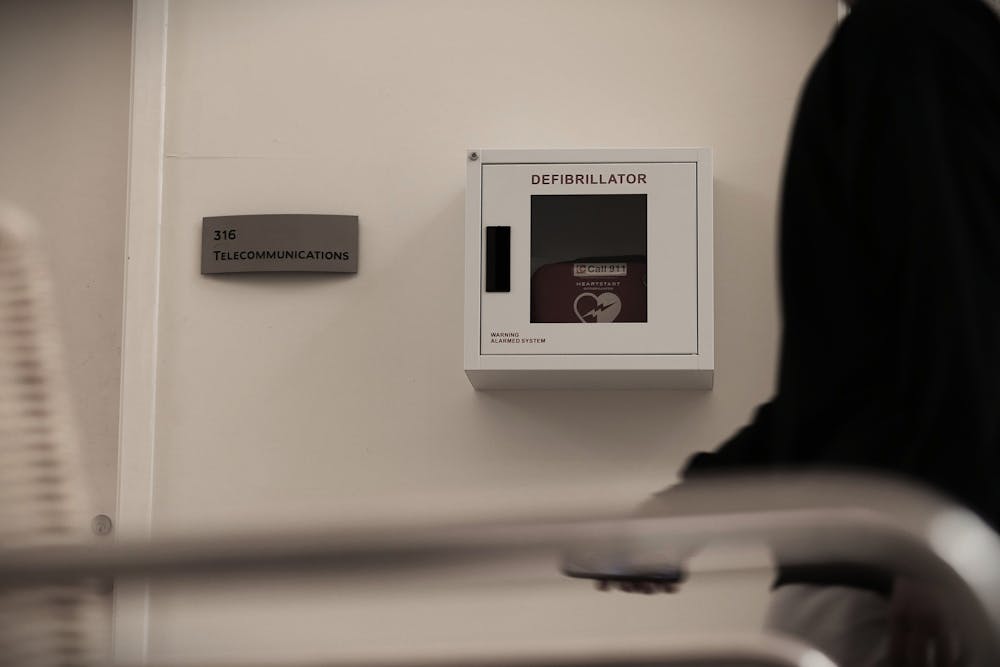
A stroll through Mercer’s Macon campus may feel indistinguishable from previous years. Tarver Library’s iconic facade still rises above Cruz Plaza, the freshly mowed lawns still glisten in the morning sun, a step into the University Center still echoes through the tiled halls. But a white metal box mounted to a wall in the UC, across from the mail center, might catch a glance.
In that box rests one of Mercer’s several dozen automated external defibrillators. The AED is used in the case that someone goes into cardiac arrest, and it analyzes a heartbeat and delivers electrical shocks to correct a life-threatening rhythm. These devices are an accessible counterpart to traditional defibrillators and are designed to be used by people without medical training.
Vice Provost Kelly Reffitt said Mercer handed the responsibility for AEDs to the Environmental Health and Safety Office within the last three years. According to their website, EHSO also oversees campus safety concerns including biological hazards, active threat guidelines, severe weather and outdoor athletics.
In previous years, each campus department separately handled spending, placement and maintenance of the equipment. The expenses were drawn from individual facilities’ budgets and lacked oversight at the university level, Reffitt said, who oversaw AED placement during a turbulent period of EHSO staff changes. Although the university now covers those expenses, individual colleges may still provide training and information. In an email sent to College of Liberal Arts faculty in March 2025, AED locations and step-by-step instructions for their use were laid out.
Mercer Police Corporal Tim Moore said EHSO moved through three directors in the last three years, and that a former director notified MerPo of the change. Neither Moore nor Reffitt could specify an exact date the transition to EHSO occurred, but Reffitt said James Calhoun is the current EHSO director and Brooke Cabrera is the assistant director. Mercer’s website lists Calhoun and Cabrera under the Office of Audit and Compliance. Contact information for the director on EHSO’s site appears as “TBA.”
Mercer published a new campus map that lists 41 blue hearts in May 2025. Each heart represents an AED on campus, excluding mobile defibrillators in athletic facilities and buildings with multiple devices. In prior years, Mercer kept a separate map for AEDs.
“When you get on an airplane, they point to the exits, right? You’ve got to know where you’re going in case there’s an emergency,” Reffitt said. “It’s the same sort of thing with the AEDs.”
No AEDs are labeled in Mercer Village or the campus apartments, but Reffitt said students living in the apartments can utilize MerPo's in-wall or mobile units.
“If you think about the residence halls, there’s a lobby,” she said. “But in the apartments you don’t have that.”
The American Heart Association recommends AEDs be within a 3-5 minute round-trip walk. On a test of the route from the Adams apartment 1975 to the MerPo station, a round-trip walk took more than eight minutes. The test did not include the time it would take to enter the buildings or grab the AED. A study from the National Library of Medicine suggests that for every minute defibrillation is delayed, the chance of survival decreases by 10 percent.
While EHSO took over the new responsibilities, two students died of cardiac arrest, which they suffered at the Outdoor Recreational Complex. In April 2023, Baba Agbaje died during a pickup soccer match. The Mercer soccer player collapsed on the field and was later pronounced dead at the hospital. In September 2024, Mason Sells died from cardiac arrest after a soccer ball hit him in the chest during an intramural match.
Sells’ death led cardiac electrophysiologist Joseph Poku to call for tighter regulations on exercise safety. Poku told 13WMAZ that in any place where exercise occurs, there should be an AED and someone who can perform CPR.
Former Mercer Police Chief Gary Mills told The Cluster in October 2024 that medical personnel responding to the scene, not MerPo, used an AED. Mills also told The Cluster that there is an AED in every MerPo squad car and that they arrived within 2-3 minutes of being called to the ORC. Reffitt said she was unaware of any changes to campus protocol after the two deaths, but she said administration had “already been deploying AEDs and first aid kits” on campus before either incident occurred.
She said the decision did not come down to one moment, but rather “the natural development of university life” to make campus a safe environment for students and employees. The move occurred to streamline safety policies and expand the budget for AEDs. During her time managing AED placement, Reffitt said she walked with the campus’ supplier once or twice per month to ensure AEDs and first aid kits functioned properly and to find the best placement for new cabinets. She said Calhoun would now hold that responsibility as EHSO director.
Calhoun and EHSO did not respond to multiple emails and phone calls from The Cluster.
AEDs are usually near “an elevator or stairwell or something that is accessible by anybody who is in a building,” Reffitt said.
Reffitt said there are multiple ways to acquire first aid training even beyond defibrillator operation. “The AEDs that they have now have voice activated instructions, so they are easy to use, but the training does help.”
Nathaniel Jordan '29 is a Journalism and Anthropology major at Mercer, and plans to become an investigative journalist. He enjoys older pleasures like reading the Sunday paper and frequents local parks with his wife and son.


