
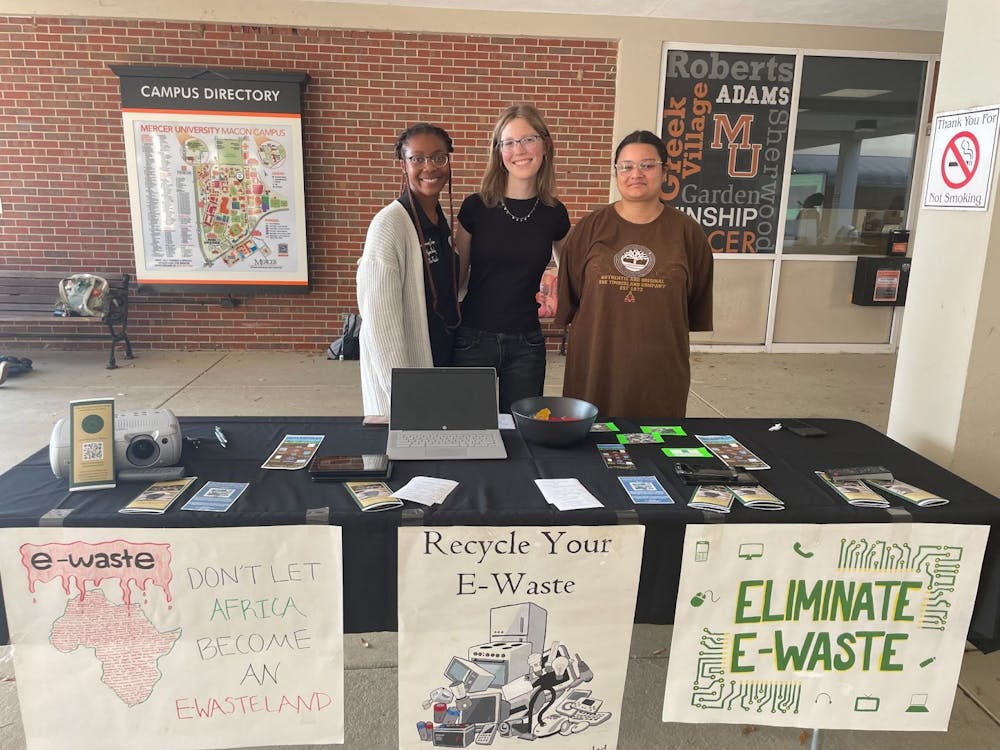
Through a research campaign focused on teaching students about electronic waste and how to prevent additional mining in the Democratic Republic of the Congo, a trio of Mercer students presented information on the humanitarian costs of producing many technological devices with elements found in cobalt in the CSC Breezeway on Wednesday, Nov. 19, 2025.
Kaylin Stone ‘27, Alyssa Ansley ‘27 and Kiera Perry ‘28 are working together to showcase the dangers of coltan mining and how consumers contribute to the term “bloody coltan.” The term, as with the term "bloody diamonds," refers to the dangerous working conditions in which coltan is extracted from the ground.
Professor of Global Health Studies Chinekwu Obiodoa is teaching students about globalization in Africa, and used the Marvel blockbuster film “Black Panther” as a vehicle for that topic in her course. In the film, "vibranium" is a fictional durable metal used to power technology in the movie's futuristic setting, Wakanda. The material mirrors the versatile and highly valuable coltan ore that is mined and, increasingly, recycled in central Africa. Group member Alyssa Ansley detailed the benefits of recycling e-waste and reusing the finite resource.
“If people learn how to recycle devices properly and corporations focus on harvesting the coltan we already have, we can reuse it for the next process instead of constantly going to the Congo to get more coltan,” she explained.
The group acknowledged that many people can unintentionally contribute to the issue when a new technological craze catches consumers' attention. However, Ansley encouraged students to not participate in technological overconsumption because many of these commodities like phones, laptops and even refrigerators can contain coltan, and "a good majority" of the labor-intensive extraction of coltan relies on young children.
“Overconsumption is just fueled by the next best thing, and people are forgetting that what they already have is perfectly fine,” Ansley said. “They don’t need to go out and spend thousands of dollars on something that has to use child labor to build it.”
The trio kickstarted their project with the launch of Toxic Treasures a website designed to provide visitors with the knowledge and resources needed to eliminate the exploitation of the finite resource. Ansley said that in order to develop a solution, the group used different resources including YouTube videos, documentaries and various initiatives like sellout campaigns as inspiration to build their site.
The group also made a donation box available for students, faculty and staff to drop off old devices. The dropbox is an accessible alternative to some electronics centers like Best Buy, which can have a limit on how many devices may be recycled at a time and may charge recycling fees per device recycled. The group is also in the process of researching some local and inexpensive electronic recycling centers that students can visit.
"A huge part of our class is just about globalization, but we need to see ourselves not separated from other parts of the world but instead connected,” said Ansley.
Though their research is rooted in the effects of improper electronic disposal in the Congo, the trio wants students to consider how domestic waste is impacting lives overall. Through educating students on how to properly dispose of old devices, the group hopes to reduce e-waste and inspire better recycling habits.
"We want everyone to walk away feeling more informed and knowing what to do. We do not want this project to be an end all, be all, but to be something that you go home and tell your families about," Stone said.
Precious Clark '26 is a Law & Public Policy major with a minor in Political Science. She works at the circulation desk in Tarver Library and Auxiliary Services. When she is not writing for The Mercer Cluster, she enjoys reading, drawing and listening to Tame Impala.


