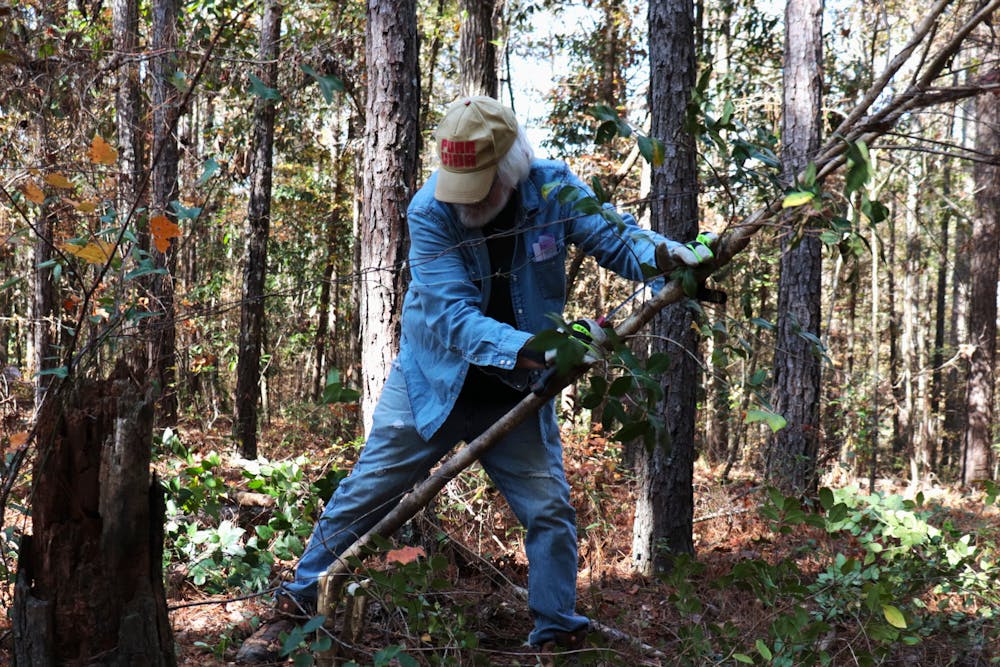
MerServe Environmental Committee member Saige Green ‘27 recalled a story her father, who works for the Upper Savannah Land Trust, told her about a century-old tree that he cared for in his backyard.
“It was, like, the most beautiful thing ever,” Green said.
However, wisteria, an invasive vine that can quickly spread through forested land, laying waste to the native plants around it, choked and killed the Green’s tree.
Birds Georgia and Georgia Native Plant Society co-organized a program that taught 15 people from Mercer University and Wesleyan College how to remove invasive plant species from Wesleyan’s arboretum in the Fearsome Five Invasive Species Outreach Program on Nov. 15.
Invasive plants grow aggressively and compete with native flora for sunlight, nutrients and space, negatively impacting environmental wellness, wildlife and “nature’s balance,” according to the U.S. Forest Service.
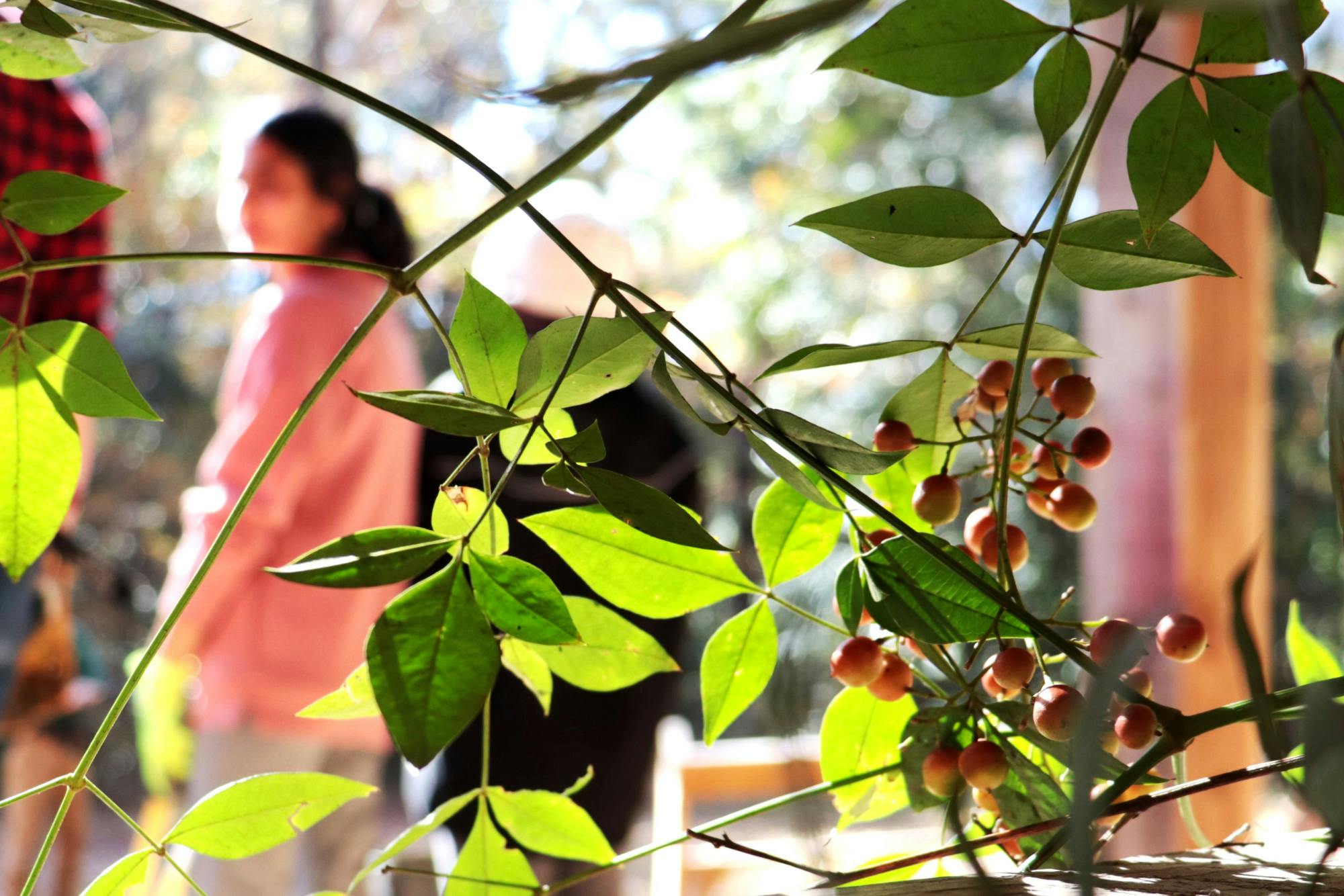
A branch of nandina laid on a picnic table while students prepared to remove invasive plants from Wesleyan’s arboretum Nov. 15, 2025.
Wesleyan Arboretum Director James Ferrari found himself in a similar position in Wesleyan’s 100-acre arboretum on Saturday as he stared at a tree engulfed by the woody wisteria vine, nearly invisible upon first glance.
“I’m not sure if that tree is even alive anymore,” Ferrari said.
Surrounded by dozens of cracked husks with seeds sprawled across the muddy grass, Ferrari pulled a two-inch pod from the vine. Wisteria pods often make a bursting sound when they are opened, revealing toxic seeds that can overpopulate gardens.
Wisteria’s rapid reproduction makes the plant difficult to eradicate. November is the peak month for wisteria reproduction, according to Ferrari. Beyond that, the plant’s excessive weight on trees tops further the struggle to remove the vines.
Addressing the issue
Birds Georgia is trying to widen their scope across the state, according to Conservation Program Manager Heather Levy, who drove from Atlanta to Macon for this program. Carol Bokros, president of the Fringed Campion chapter of the Georgia Native Plant Society, brought along a wagon of equipment and largely managed the project. Bokros also works for Mercer as director of pre-health professions advising.
“We like it when we can join onto something that’s already happening,” Green, who mentioned her committee often works with Bokros, said. “They’re doing important work.”
Ferrari provided a lesson on the “fearsome five,” a nickname for a group of common invasive species in Middle Georgia: nandina, glossy privet, English ivy, bahiagrass and autumn fern. While Ferrari did not discuss Bahiagrass, he showed examples of the other four species to the students.
The arboretum, which is a botanical collection of woody plants that is home to hundreds of native trees and shrubs, provides a diverse habitat for Macon’s wildlife.
“Any forest you leave alone for very long is going to start getting intruded upon by non-native plants,” Wesleyan’s Arboretum co-founder Barry Rhoades said. Those plants, Rhoades said, evoke a particular danger for plants, reptiles, amphibians and the estimated 150 birds that live there.
The majority of the arboretum’s invasive plants originated in east and southeastern Asia, which Rhoades said has a climate similar to the southeastern U.S. Nandina, glossy privet, autumn fern and wisteria are all popular, ornamental landscaping plants that are native to China and Japan. Rhoades said he often finds invasive species on shelves at home improvement warehouses.
“It definitely is sad,” Green said. “You’ll go into Lowe’s, and you’ll buy these plants, but they’re actually really harmful for the environment.”
Bokros, Green and Rhoades all said the best solution to invasive plant growth is community involvement. The six experienced volunteers opted to have their groups forgo removing certain plants due to the time constraints.
Rhoades said he is working on establishing an adopt-a-plot system for the arboretum, which would offer a workaround for a budget that is often stretched. It would also allow an individual or organization to claim responsibility for keeping a section of the forest clear of invasive plants.
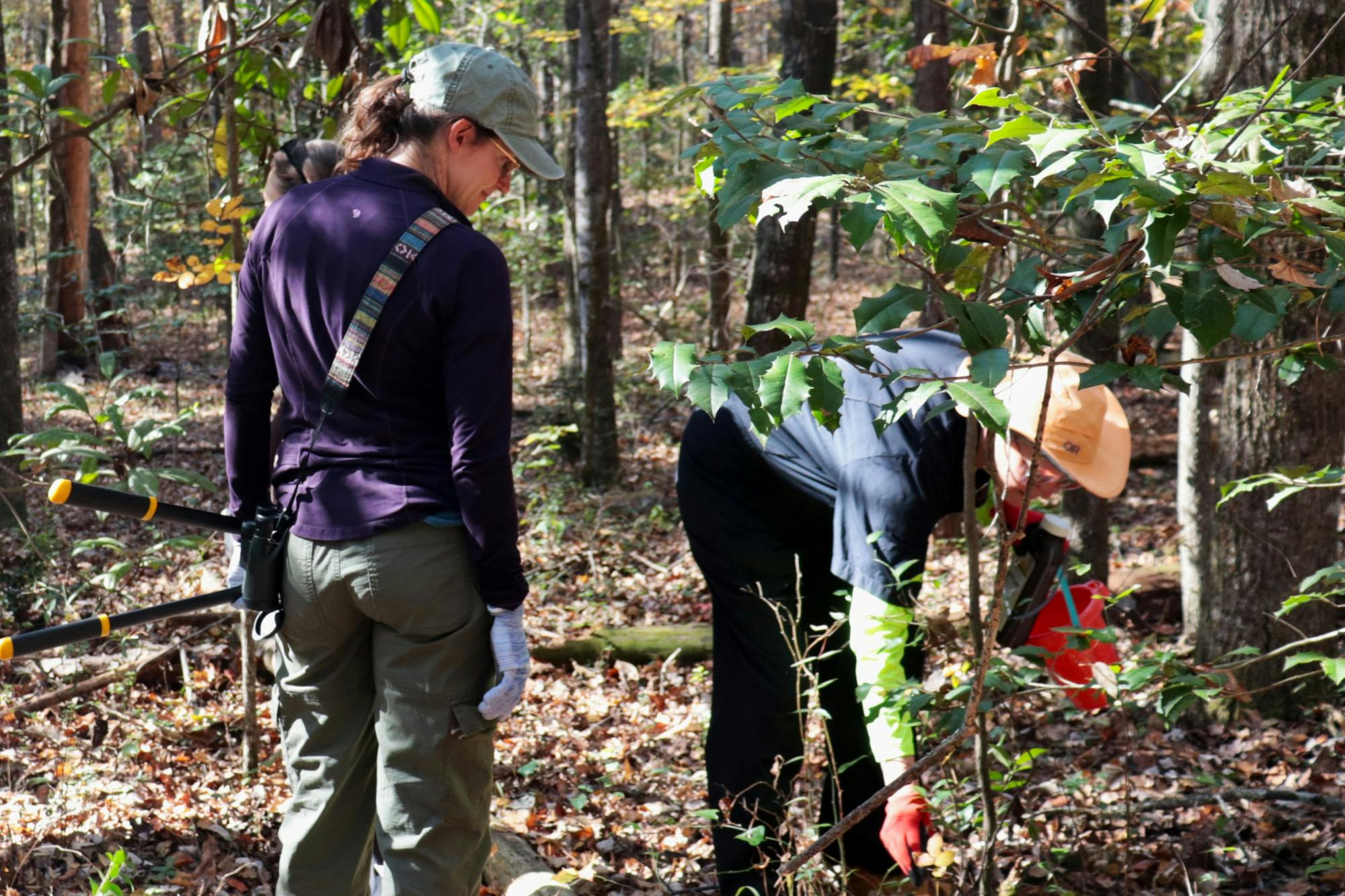
Birds Georgia Conservation Program Manager (left) and Carol Bokros, president of Georgia Native Plant Society Fringed Campion Chapter, removed invasive plants from Wesleyan arboretum Nov. 15, 2025.
“If we keep on doing events like this every few months, we’ll make a pretty good dent in it. More students to volunteer would be amazing,” MerServe executive director Aleem Patni ‘27 said.
The crew broke off into groups led by the six experts. As they scattered across the woods, Rhoades sawed down a 12-foot glossy privet, chopping it into thirds. Privet was scattered all across the forest, some small enough to pull by the stem while others had to be removed using power tools.
Ferrari, who has researched the ecology of fruit-eating birds, said other plants are difficult to catch for the beginners. For example, the poisonous nandina has a similar structure to the native beautyberry, a vital food source for local bird populations.
Managing the land
Rhoades took on his current role as arboretum manager shortly after retiring from his work as a biology professor in 2024. He has overseen the woodland since he helped found it in 1996, but only recently managed to secure an increased budget from Wesleyan. For years, Rhoades said the arboretum operated with $2,700 per year.
With an unspecified amount reallocated from Rhoades’ salary into the arboretum budget, the fund now totals $30,000. He said the last three Wesleyan presidents have supported keeping the arboretum.
“I think the current (administration) is pretty committed. For others, it’s just been kind of a nuisance of vacant land,” Rhoades said.
“I hope to see it remain a woodland, and there’s no guarantee that it will. It’s an attractive piece of real estate,” Rhoades said. “It’s good for public relations for the college, but it does not bring in a lot of revenue.”
The arboretum needs “more people helping out, more people knowing what’s native and not,” Green said. “We’re not trying to make it pretty. We’re just trying to remove the invasive species so the native species can live and flourish.”
Nathaniel Jordan '29 is a Journalism and Anthropology major at Mercer, and plans to become an investigative journalist. He enjoys older pleasures like reading the Sunday paper and frequents local parks with his wife and son.