
This is an opinion article. Any views expressed belong solely to the author and are not representative of The Cluster, any organizations the author is a member of or the faculty, staff or administration at Mercer University.
Artificial intelligence is often described as invisible — something that floats in the cloud and that quietly improves our lives from behind a screen.
Until recently, I did not question that metaphor. As a Mercer student in Georgia, I once relied heavily on AI tools for studying, writing and research and rarely considered what powered them or what they demanded from the environment around me. But the idea that AI is weightless or immaterial is an illusion that researchers warn is becoming increasingly dangerous.
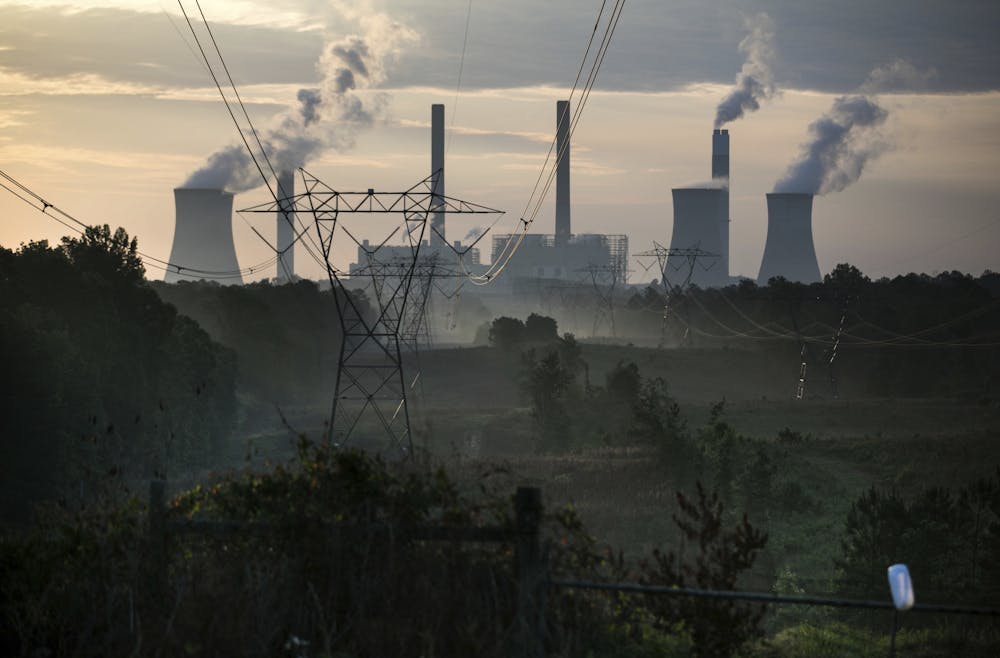
AI may be digital, but the systems that power it are deeply physical. According to the International Energy Agency and reporting by The New York Times, AI systems rely on massive data centers, constant electricity demand, water-intensive cooling systems and environmentally destructive mining operations. And while these costs feel distant when we’re staring at a laptop in a campus library, they are very real. Especially here in Georgia.
Across the state, data centers are expanding rapidly. Georgia has become one of the fastest-growing hubs for data infrastructure in the Southeast, drawn by relatively low energy costs and available land. These facilities operate around the clock and consume enormous amounts of electricity.
The U.S. Department of Energy estimates that a single large data center can use as much electricity as tens of thousands of homes, and the International Energy Agency projects that global electricity demand from AI-driven data centers could quadruple by 2030.
For students, this matters more than we might think. Georgia relies heavily on fossil fuels for electricity, meaning AI’s growth may be directly tied to rising greenhouse gas emissions. Every AI-generated answer, image or recommendation triggers layers of computation across multiple servers, drawing power long after we close our browsers. A task that takes seconds for us carries an environmental cost that lasts much longer.
To put this into perspective, researchers estimate that operating large language models like ChatGPT produces significant carbon emissions each year—potentially exceeding the annual footprint of an average individual. That is just one system. Multiply that footprint across countless AI models embedded in education, banking, health care and entertainment and the scale becomes impossible to ignore. By 2030, data centers worldwide could consume nearly 945 terawatt-hours of electricity annually—comparable to the total energy use of some entire countries, according to the International Energy Agency.
Energy is only part of the story. AI systems also depend on water, a crucial resource during drought seasons, to cool the data centers that power their calculations. Investigations by the U.S. Geological Survey and environmental journalists have revealed that data centers can consume millions of gallons of water daily for cooling, much of which is lost to evaporation.
In 2023 alone, U.S. data centers used an estimated 17 billion gallons of water, a figure expected to rise sharply in the coming years. As climate change intensifies water stress across the Southeast, the expansion of data centers for AI raises serious questions about whose needs are prioritized.
Beyond energy and water, AI rests on a foundation of extraction. As researcher Kate Crawford explains in Atlas of AI, the minerals required to build AI hardware, lithium, cobalt, copper and gold, are often mined under environmentally destructive and ethically troubling conditions. These impacts are hidden behind sleek interfaces and abstract metaphors, allowing users to believe AI exists apart from the physical world. It does not.
Some argue that future AI systems will become efficient enough to solve these problems on their own. While technological improvements are real, efficiency has not slowed overall consumption. In many cases, it does the opposite: cheaper and faster systems encourage more, not less, use in a pattern economists describe as the rebound effect. Meanwhile, efficiency gains do nothing to address the mining, manufacturing and electronic waste embedded in AI’s supply chains.
This is where the responsibility of students, universities and states like Georgia comes in to play.
Mercer, like many institutions, is exploring how AI fits into classrooms and campus life. That conversation should also include where our digital tools come from and what they cost the environment. At Mercer, where AI tools are increasingly part of coursework and academic support, these decisions shape how we learn every day.
Universities must demand transparency from the companies whose platforms they adopt, prioritize vendors powered by renewable energy and integrate environmental accountability into technology policy. Students can practice digital restraint, using AI intentionally rather than reflexively and push for sustainability to be part of campus tech decisions.
At the state level, Georgia lawmakers can require clearer reporting on energy and water use from data centers, invest in renewable-powered infrastructure and ensure that rapid technological growth does not come at the expense of local communities. These are not anti-technology positions, instead they are pro-accountability.
This technology has the potential to support sustainability, education and innovation. But only if we stop pretending it is consequence-free. As users, students and residents of a state increasingly tied to digital infrastructure, we have a stake in how this technology develops.
The cloud is not floating somewhere far away. It is plugged into our power grids, drawing from our water supplies and shaping our environmental future. Ignoring the true cost of artificial intelligence is no longer an option and the responsibility to confront it starts here.
Kaylee Grace Buchanan '29 is double majoring in Criminal Justice and Psychology with an minor in Religion. When not writing, she enjoys reading, baking and playing tennis. You can also catch her on the pickleball courts jamming out to some music as well.


