The history of the Mercer Bear is a long, confusing, rocky path of identity. From black bears to brown bears to white-black bears and black-brown bears, Mercer has yet to determine its own species.
Mercer’s original namesake was the Baptists, but when, allegedly, a crowdmember at a football game between Mercer and the University of Georgia in 1892 called out, “Whence cometh that bear?” the Bears became the unofficial mascot of Mercer until the student body voted to make it official in 1924, later voting to dub him Toby in a 1949 contest sponsored by The Mercer Cluster.
Apparently, the spectator “did not call out what kind of a bear he envisioned,” according to an email sent in 2004 by former-Archives Assistant Arlette Copeland.
The question is now, 134 years later, whence cometh what bear?
It is likely the distinction didn’t matter in 1924. Even today, the school’s Marketing Director Larry Brumley believes the answer is of little consequence, citing Mercer alumna and famed TV personality Nancy Grace, who told The Cluster in January that Mercer’s mantra is “‘Be the Bear,’ not ‘Be a Bear.”
“It means to be the Mercer Bear, which stands for everything good and true,” Brumley said. “It also means to be determined, diligent and ferocious when it comes to accomplishing your goals.”
While Grace categorized Mercer’s bear as its own species, Mercer’s Double Bear President Penny Elkins advocated for a student vote on the matter.
Mercer’s defunct student magazine, “Bearskin,” published an opinion piece in 1949 that called for a new bear statue.
“We have brown bears, white bears, black bears, polar bears, cinnamon bears, golden bears,” the author wrote. “But unless we delve into ancient Aztec or Mexican art or – perish the thought – Art Moderne, we have found nothing to compare with ours.”
What do the presidents say?
Mercer's administration did not answer the question under former president Bill Underwood.
“Settling on a species of bear mascot is really not important. It’s not the focus,” Brumley said. “It’s what we want the bear to represent.”
Elkins was more direct and told The Cluster in January she believes “Mercer Bears are solidly those black bears.”
She said black bears represent the student body because they are the only species native to Georgia. She noted their unique intelligence, saying studies proved black bears could recognize human behaviors to determine the time of day they will eat.
Members of the school are “very insightful. We watch our communities very carefully, and in our case, we are making sure we are intervening at times where our community needs it,” Elkins said.
What do experts say?
Toby and Tot “most closely resemble the American black bear,” according to Assistant Professor of Biology Rebecca McKee, who specializes in animal behavior, wildlife ecology and conservation.
McKee identified the species in seven photos, which included variations of mascots Toby and Tot, the current Mercer Bear logo and the Sailor Bear logo.
A signature trait among black bears is sexual dimorphism, which means males grow to become significantly larger than females, McKee said, and the height gap between Toby and Tot closely resembles this ecological trait. The Sailor Bear’s slimmer face also resembles that of a black bear.
However, the current logo’s shaggy fur and the brown coloration Toby and Tot’s early designs resemble a brown bear, McKee said, which are not native to Georgia. They can be found in the northwestern United States and parts of Europe.
What do archives say?
Mercer’s archives house over 100 documents related to the bear mascot’s development. The University ordered blankets for the football team after the official mascot switch.
“Each blanket will have a great black grizzly on an orange background,” The Mercer Cluster reported.
On Bear Day in 1949, students were photographed “bowing down” to a white bear near Ryals Hall, according to Copeland’s 2004 email.
This white bear is a subspecies of the black bear called the kermode bear, otherwise known as the spirit bear. About 10-20% of these bears develop white fur, according to a 2001 study published in Current Biology. The kermode bear is native to Canada, and only 100-500 of the white-colored bears exist today.
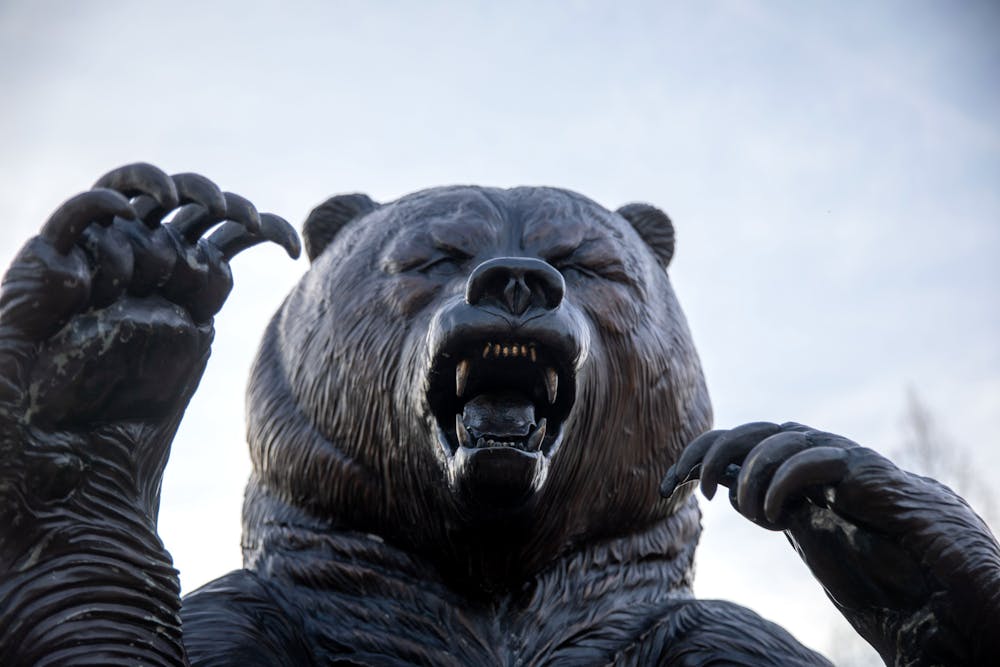
More recent archives contain articles about the campus bear statues, which, according to Brumley, sparked the most recent questions about the Mercer Bear’s species. Both the statue outside of the University Center and Five Star Stadium closely resemble brown bears with their shaggy fur and strong roars, and they were each provided by donors.
When Mercer dedicated the UC bear with a prayer, the bear was described as “ferocious” and “tenacious,” a term synonymous with brown bears and Mercer rhetoric.
In 2010, The Macon Telegraph reported on the UC bear and gathered student opinion.
“It’s a nice display, but I don’t feel the connection,” Vu Huong ‘14 told The Telegraph. “The bear doesn’t describe us here very well. It looks too fierce and aggressive and warrior-like.”
Huong was not alone in this sentiment.
Cody Quatlebaum ‘14 said he expected a “teddy bear type of deal.”
The message of the Mercer Bear is historically foggy. Student publications shared cartoon illustrations depicting a range of bear faces from cuddly teddy bears to rat-like sketches.
The men’s basketball team took portraits with a real black bear in the 1970s. Their logo resembled a grizzly around the same time.
Emily Ostein ‘29, who comes from a long family tree of Mercer alumni, said, “I’m no bear expert, so we have never discussed this in my family. We’re just like ‘Oh, a bear, take a picture.’”
Ostein’s friend, Allie Mahoney ‘29 weighed the character of the species against that of the student population.
“Black bears, I see them as more, like, reserved. Mercer students are not. We’re a bit more out there,” Mahoney said.
The duo recalled all the variations of a bear on Mercer’s campus, and eventually looked up pictures of Toby to confirm they thought he is a black bear and not brown.
Elkins said she would like to see the decision come down to the student body. She proposed assisting with a student vote, but Brumley said the previous, unspecific administration’s conclusion will likely remain.
It could be a teddy bear or a 10-foot kodiak, but ultimately the bears plastered on t-shirts and guarding stadiums fall into the same family: the Mercer Bears.
Nathaniel Jordan '29 is a Journalism and Anthropology major at Mercer, and plans to become an investigative journalist. He enjoys older pleasures like reading the Sunday paper and frequents local parks with his wife and son.