
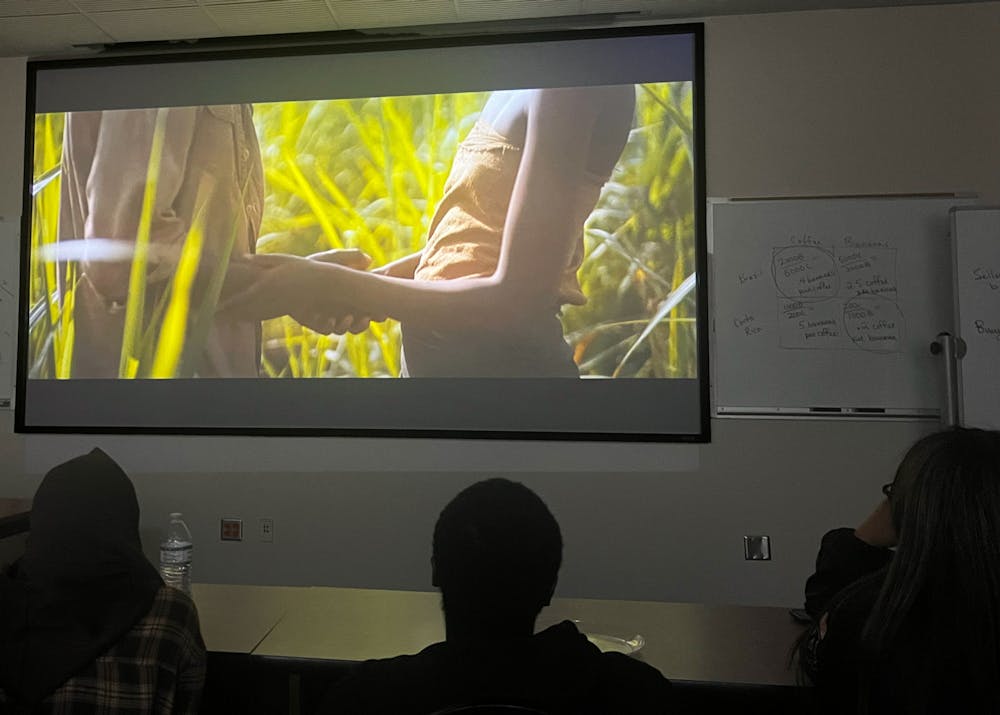
Chinekwu Obidoa, a Global Health and Africana Studies professor and creator of Mercer's Africa Film Series, hosted a screening of Justin Chadwick’s “The First Grader” in collaboration with QuadWorks Thursday, Sept. 18. The film tells the true story of Kimani Ng'ang'a Maruge, an 84-year-old Kenyan Mau Mau freedom fighter who attended primary school following a new free education decree. Throughout the film, he struggles with post-traumatic stress disorder and social struggles as people from school were unwelcoming as a result of his age.
Obidoa started the film series in 2021 because she realized students did not know much about Africa and the Mercer curriculum did not offer adequate courses to fill the gaps in their knowledge. “We are a globalized village,” Obidoa said. “We are training students to change the world — how can you change a world you don’t know?”
To remedy this, she decided to supplement students’ understanding of Africa through film, and Obidoa chose to screen “The First Grader” to provide insight into the colonial experience.
“One of the themes of the film is that the past is always present with us,” Obidoa said. “While we put the colonial experience in the past, the truth is, it’s not in the past. The lives of the people are still being shaped by that experience.”
Fatima Kamara ‘26 enjoyed the film’s focus on the importance of education because her parents, who are from Sierra Leone, say they grew up without that emphasis. When they moved to America, they told both Kamara and her brother to take education seriously.
“Even though Maruge didn’t have an education during his youth, his main priority of the movie was to learn how to read,” Kamara said. “It just shows at any age, education is still important.” She said she believes that learning one new thing every day will change the world.
Djamila Mungbet Nku ‘26, who immigrated to the United States from Cameroon, said she felt surprised seeing the era of colonization in Kenya. Seeing the Mau Mau killed by British colonists and the Kenyans submit to them led Mungbet Nku to consider the rights she has now.
“Here, you have the right to speak your voice,” Mungbet Nku said. "It’s a privilege we overlook sometimes.” She explained that in the past, Kenyans didn’t have a choice, which she found mind blowing. “It’s kill or be killed,” Mungbet Nku said.
Obidoa held a discussion for students to reflect on the film and how it affected them. Obidoa puts together these screenings monthly, and she will screen “City of Joy,” a film that relates to globalization with a focus on the Democratic Republic of Congo, in October.


