
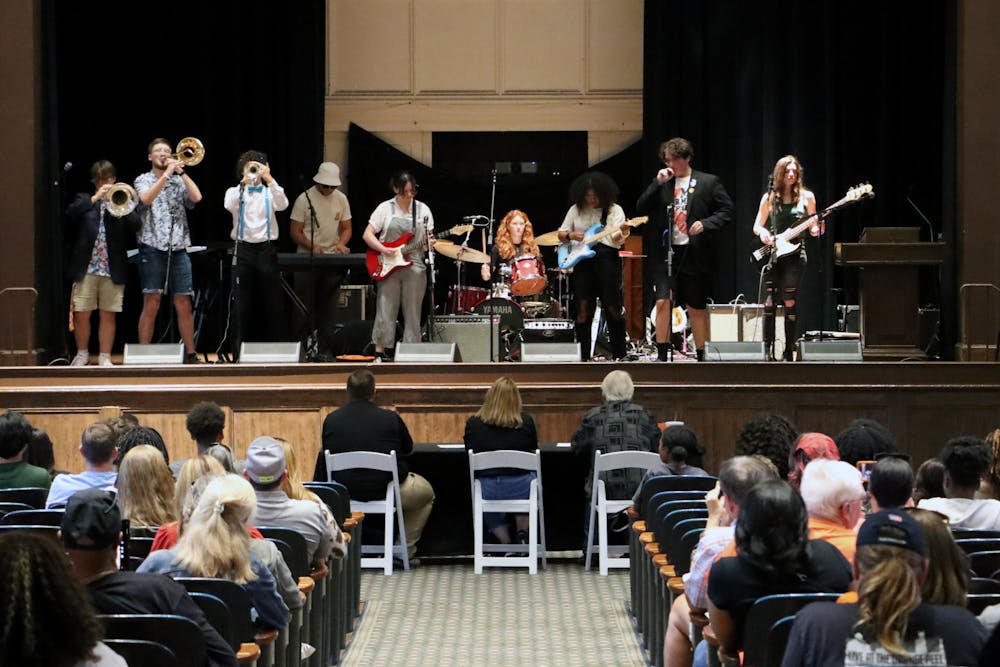
QuadWorks hosted Cubstock, a talent show to discover the opener for Bearstock next semester, on Oct. 3. Kosher Pickle, a ska band formed months before, opened Cubstock with three pieces utilizing punk and reggae influences.
The chemistry between the members built throughout their first ever public performance as the band started its second song. William Little ‘28, Owen Pope ‘28, and Blaine Wilkerson ‘28, a co-founder of Kosher Pickle, on the trumpet, euphonium, and trombone respectively, stomped in a line while swaying their arms to the beat. Elliot Keyser ‘28 and co-founder of Kosher Pickle on vocals, ripped up the stage while interacting with guitarists Megan Hobbie ‘28 and Rayah Solomon ‘28. Kiah Shealy ‘26 on the keys, Kenlea Day ‘26 on the drums and Claire Bussler ‘28 on the bass guitar brought everything together.
By the end of the performance, the audience erupted with whistles and roars. The smiles widening across band members' faces beckoned more cheers.
But who are Kosher Pickle, the band who placed second in the talent show? And what is with that name?
It came to him in a vision, Keyser joked, it was just a silly idea that, as these things naturally progress, turned into reality.
“What if we started a ska band and we called it something really dumb like Kosher Pickle?” Keyser said he asked his now-bandmates. “And it spiraled from there.”
With that, the band was formed around two months ago, and they began gathering players.
“I said, ‘What’s the haps? What’s up?’” Bussler said. “And [Keyser] said, ‘We’re putting together a ska band.’ I said, ‘Hell yeah! I’ll play for you.’”
Their inspiration for Kosher Pickle springs from different wells.
Wilkerson emphasized the excitement that came with forming a band that played a more niche genre of music, which had not been performed widely on campus before.
Ska, a Jamaican style of dance music, originated in the late 1950s. It incorporates elements of American rhythm and blues with Caribbean mento. Traditionally, ska has guitar and piano on the upbeat, bass on the downbeat while utilizing offbeat. Many ska bands play with a walking bass line, a steady quarter note rhythm that moves like steps. Some include No Doubt, The Specials and Desmond Dekker.
The widely accepted origin of the term, “ska,” comes from Ernest Ranglin, an early ska musician who and session guitarist for multiple record labels. Ranglin said that when the genre was in its infancy, musicians likened a guitar "scratch" to the word skat, but there is no one accepted theory as to the origins of ska's name.
“I was listening to a lot of Jeff Rosenstock and Streetlight Manifesto. I was like, it would be really fun to make a band out of this.” Keyser said. “Most of us are brass players. Being able to have a punk band that has that kind of influence would be really fun.”
Ska punk is a fusion genre that mixes ska with punk rock, and it tends to put emphasis on horns. It is closely tied to third-wave ska from the mid-1990s. Some examples include Streetlight Manifesto, Operation Ivy and Fishbone.
A major difference between Kosher Pickle and the other acts at Cubstock was this ska punk style. While the band MotherFunka had horns, Kosher Pickle used them prominently as whole sections focused on horns.
“I like to play gigs,” Bussler said, “It’s fun to play some quick little songs, put on a show and get to work on things.”
When asked what is in the band's future, they laughingly mentioned Bearstock and a plan that is in the works for next semester.
“A trade secret that may be revealed shortly,” Bussler said, giving nothing away. But the musicians were more forthcoming about how they enjoyed their first gig.
“Highlight of my year so far,” Keyser said excitedly. “It was amazing.”


