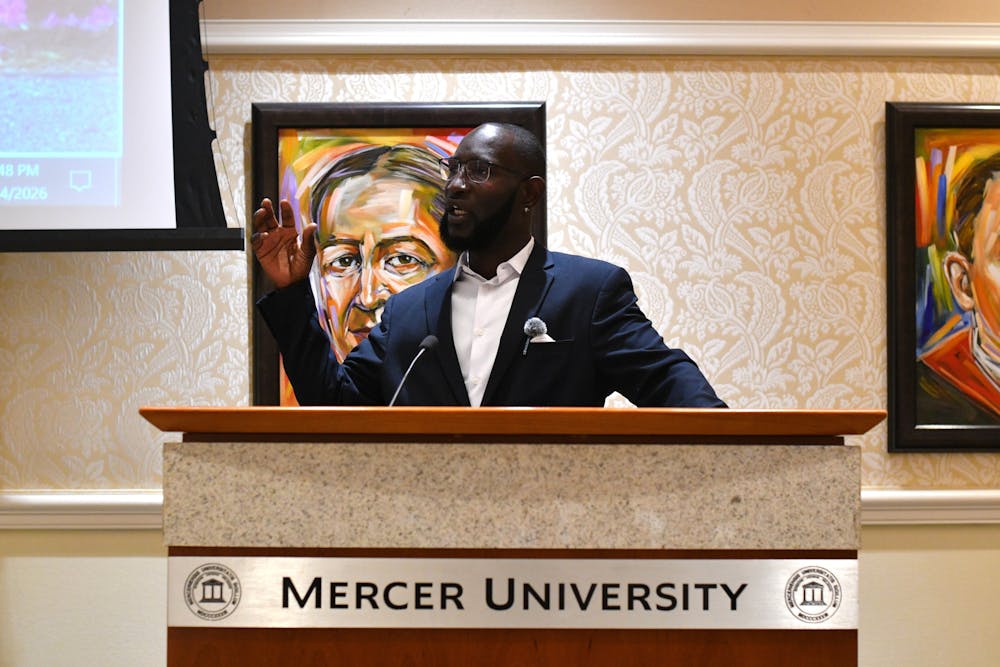
Shareef Cousin stood in front of a crowded Presidents Dining Room on Tuesday, April 14, and told the crowd that the legal field is not merely a career path, but a heavy responsibility that places “people’s lives in your hands.”
The presentation, titled “Death Row, Exoneration, and (Re)building a Life,” was hosted by Mercer’s Spencer B. King, Jr. Center for Southern Studies.
Cousin was once the youngest people, 16, to be sent to Louisiana’s death row after he was convicted of killing a man in New Orleans’ French Quarter.
Cousin used the firsthand account of his wrongful conviction to bridge the gap between abstract legal theory and permanent consequences of going through the justice system.
When asked what he hoped students would take away from his experience, his answer was direct.
“Be a fighter,” he said.
“You're young and going into careers where you're gonna have people's lives in your hands,” Cousin told the audience, which included about a dozen Mercer Law students. “Going into the law field is a lot of responsibility, but it’s also very rewarding when you get cases like mine and win.”
Introduced by Director of the Spencer B. King Center Douglas Thompson and Mercer Law Professor Sarah Gerwig, Cousin recounted the mechanics of his 1995 arrest when he was just 16 years old. He detailed how the prosecution withheld evidence regarding the sole eyewitness, who lacked her corrective lenses, and ignored leads that pointed to other suspects.
While the Louisiana Supreme Court eventually reversed his conviction in 1998 due to prosecutorial misconduct, Cousin emphasized that his “liberation” was not immediate upon walking out of prison.
The discussion after his presentation centered heavily on “displacement” – the lasting psychological toll and "institutionalization" that follows years of being confined for 23 hours a day.
Cousin was candid about his personal struggles following his release, including failed marriages and the difficulty of connecting with his seven children while carrying a survival mindset.
“You’re not just taking away our freedom – you’re stopping our growth,” Cousin said, describing how his 10-year-old and 12-year-old sons eventually became “mirrors” of himself, reflecting the emotional distance he had used as a shield in prison.
To break the cycle, Cousin recently gave up his home to travel the country in an RV with his sons, seeking a deliberate counterweight to the rigid, forced routine of incarceration. The message resonated with students like Catherine Spainhour ‘28, who said the talk moved the law out of textbooks and into reality.
“It takes you out of the textbooks and back into real life,” Spainhour said. “I hope it encourages others to actually help people and not just get lost in the tracks.”
Cousin, who received no financial compensation for his wrongful conviction, concluded the event by urging future professionals to remain vigilant. He noted that his story is not limited to the courtroom, encouraging attendees to join organizations and advocate for change wherever they see a need.
Years after his conviction was reversed, Cousin met the prosecutor in a Louisiana courthouse whose work put him behind bars. Cousin offered the man forgiveness, but told the crowd Tuesday that the lost years could never be recovered.
“Freedom is not about the absence of bars,” Cousin said. “It’s about the presence of dignity and the courage to live beyond survival.”
Kaylee Grace Buchanan '29 is double majoring in Criminal Justice and Psychology with an minor in Religion. When not writing, she enjoys reading, baking and playing tennis. You can also catch her on the pickleball courts jamming out to some music as well.