
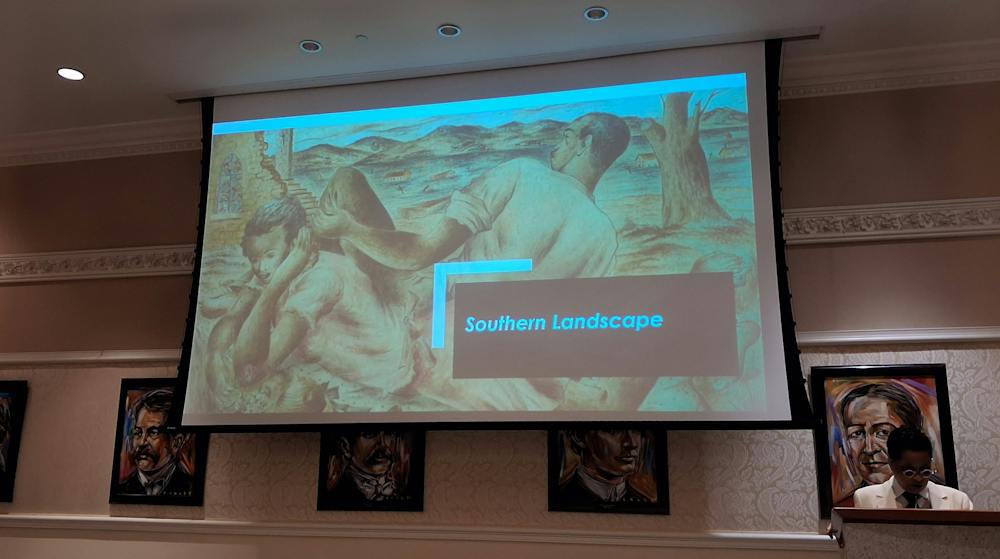
Sharon Holland, professor of American Studies at the University of North Carolina--Chapel Hill, delivered the Lamar Lectures on Monday and Tuesday in the President's Dining Room. The Lamar Lectures are hosted annually by the Spencer B. King Center for Southern Studies at Mercer with a goal of promoting "the permanent preservation of Southern culture, history, and literature," per the series' website.
Holland, who attained her Ph.D. in English and African American Studies at the University of Michigan, has written multiple award-winning books and primarily researches topics at the intersection of queer theory, black history and feminism.
Holland said that the lecture series in Macon fit the region's character well. “Given that the next arc of my research focuses on visual cultures in the South,” she said, “this was a perfect opportunity to think through the work of Southern Iconographies and how they endure and are troubled by a range of artists over the last century."
“At this moment in our nation’s history, it is imperative that intellectuals take on the thorny “why” and “how” questions,” she said.
Holland's first lecture opened with her analysis of Eldzier Cortor's artistic work. Cortor was a 20th-century African-American artist who was uniquely influenced, in Holland's eyes, by African surrealism and the gendered body. Holland primarily analyzed his two works "Southern Gate," which depicts a partially nude female in a barren Southern field, and “Southern Landscape," which depicts a Black couple in the middle of a deadly flash flood from 1939.
Then, during her second lecture, Holland discussed work by W.J. Cash, a 20th-century journalist famous for his work on the South and Southern culture. Cash’s work sets up the purposefulness of the gendered expectations about America’s plantation system, driving them to less desirable land, Holland explained.
While Cash’s theories had little scholarly work to back them up, Holland said it helped understand the voices of young white men during that time.
During this lecture, she also spoke about the role of Black women in the south, being tethered to a reproductive life and used by boys on the plantations throughout the boys’ manhood and marriages.
“The institution of slavery bred cruelty that no reflection of honor could successfully retain,” Holland said. “Who will we become if we do not heed to our history?"
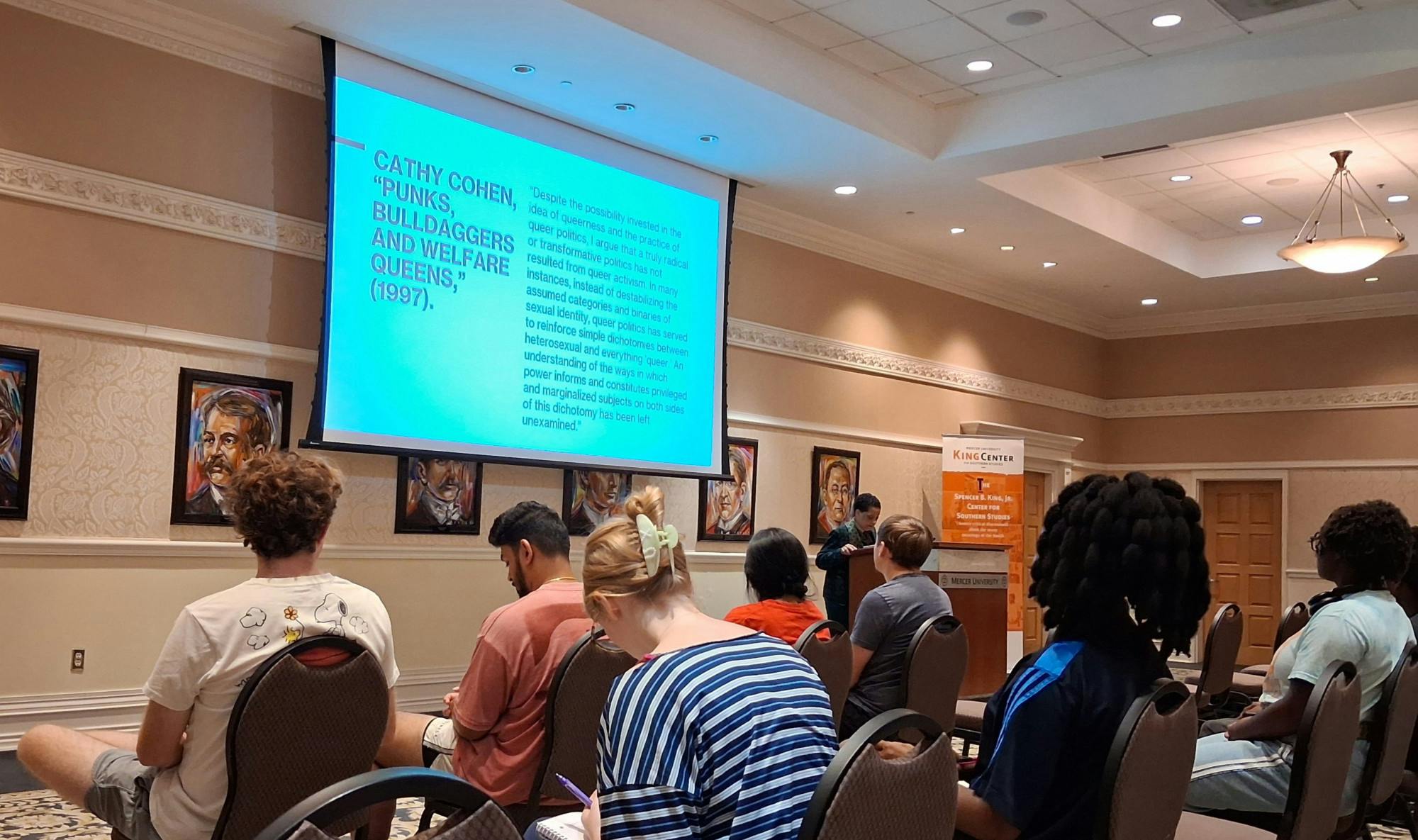
Sharon Holland speaks as part of the annual Lamar Lecture series at Mercer University on Tuesday, Oct. 6.
At the end of the second lecture, Holland took questions from Mercer students on blackness and her experience in the south. Holland said her first memory was at four years old after Martin Luther King’s assasination, when she saw tanks outside the front porch of her house driving along the street. She said that this, in combination with her observations about black culture and the family, drove her interest in her current academic field.
She said one of her main goals was to change and complicate the way students think about the world. “I want students to think beyond absolutes,” Holland said. “To understand that the very questions they might have about why certain aspects of our culture endure were asked, are being asked by creatives then and now.”
The third lecture opened with an excerpt from Cathy Cohen’s “Punks, Bulldaggers, and Welfare Queens” in 1997, which discussed two decades of HIV/AIDS activism in the U.S. Holland also analyzed a charcoal painting by Greg Tate, an outsider creative who Holland took special interest in because of his status as an untrained artist.
“Why do you need to be outside of certain geographical places for someone to pay attention?” Holland asked.
Holland also incorporated her own experience as a black queer person in her research and her lecture as well. She said that when the AIDS crisis was raging, the queer community she was a part of felt like they needed to keep living their lives, partying until early in the morning in order to keep resisting and fighting against people who were trying to put them back in the closet.
Other paintings by J. Alan Cumbey, a white gay man who created complex drawings detailing his identity, were then featured. Holland said Cumbey pictured himself as a Black man, describing his relationship to blackness as psychic rather than transactional.
The painting, “Rag Doll #2”, reflected the fallibility of modern medicine, Holland said. The subject, who was a Black woman, looked to be in a hospital bed, the right side of her body being taken apart. Holland analyzed the painting in relationship to the iconography of Black women and their suffering.
What is most important throughout art analysis, Holland said, was ultimately “which iconographies belong to us, and which iconography belong to a community of others that we don’t know.”


